The Performance of Apocalypse
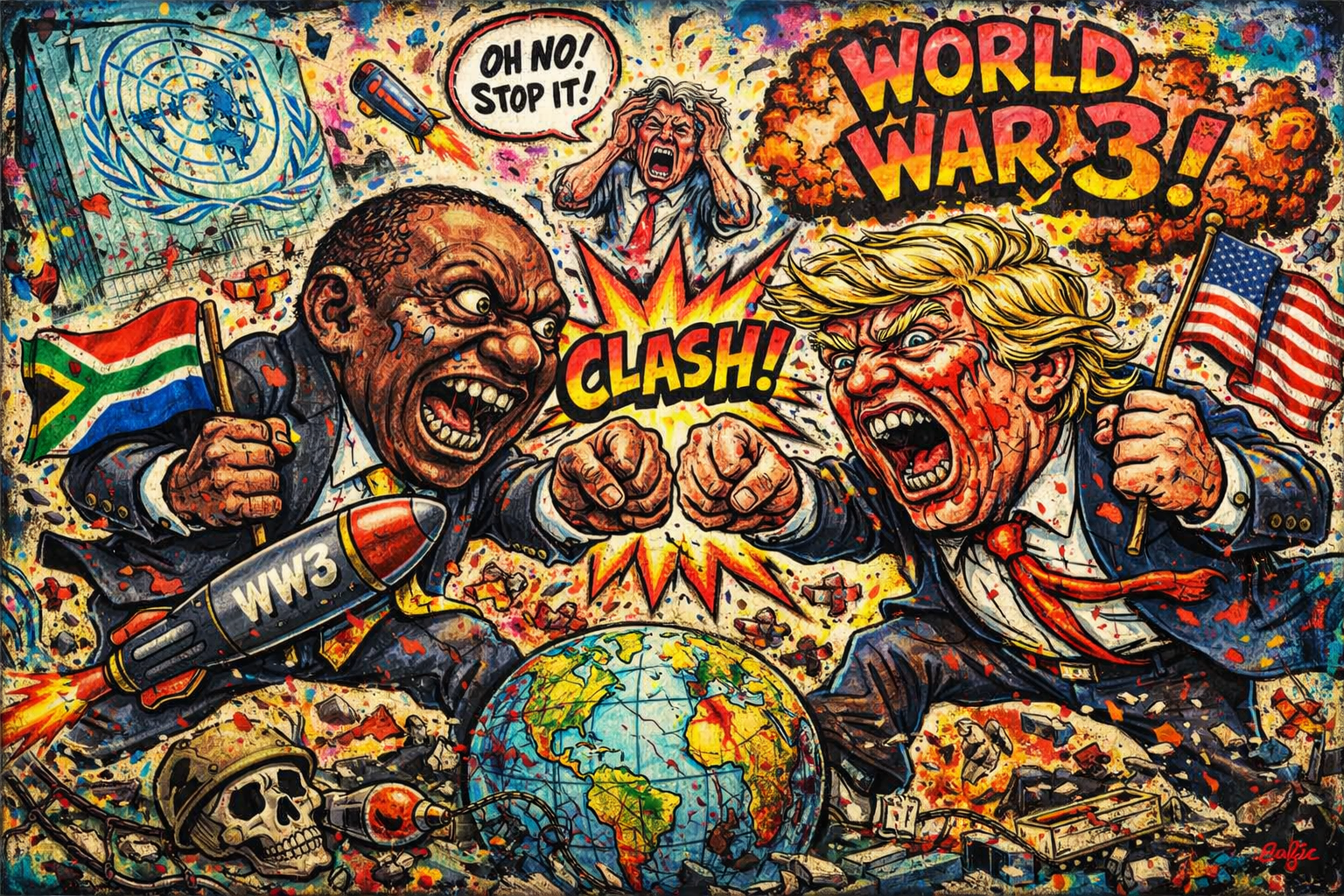
The most dangerous place on Earth is not the Taiwan Strait or the South China Sea or wherever your uncle suddenly learned to pronounce last week. It’s the space between a man’s mouth and the microphone when he realizes the camera is on and he has a chance to feel important again. That’s where wars are born now. Not from ideology or scarcity or even old grudges, but from the raw, uncut terror of being ignored.
So yes, let’s entertain, because everyone already is, the idea that a diplomatic dust-up between Cyril Ramaphosa and Donald Trump could somehow kick off World War III. Not because it’s likely, but because the way people react to the idea tells you everything about how we’ve decided global catastrophe is supposed to work in the modern age.
The scenario usually goes like this: Trump says something loudly stupid about South Africa, land, crime, “tremendous people,” you know the rhythm. Ramaphosa responds like a man who has read briefing papers and expects to keep doing so. The internet then immediately decides this is the opening move of Armageddon. Threads bloom. Think pieces sweat. Grown adults begin typing “this is how it starts” with the solemn excitement of kids lighting fireworks near gasoline.
Everyone pretends to be afraid. No one actually is.
Content Over Catastrophe
Because the truth is, we don’t imagine World War III as horror anymore. We imagine it as content. A sequence of clips, statements, counters, maps with arrows. Something we can follow, analyze, argue about, and feel briefly superior for having predicted. We don’t want nuclear war; we want the dopamine hit of proximity to it. We want to feel like we’re standing near history without having to do anything brave, useful, or irreversible.
Trump understands this instinct perfectly. He’s not a geopolitical strategist; he’s a vibes merchant. His power has always been the ability to turn attention into oxygen and then light a match. He doesn’t threaten because he believes in outcomes. He threatens because silence feels like death. When he says something reckless about another country, it’s not foreign policy, it’s performance art for people who confuse volume with conviction.
Ramaphosa, meanwhile, is trapped in the thankless role of the adult in the room, which means he gets framed as either weak or sinister depending on the mood of the crowd watching from the cheap seats. Calm responses are treated as chess moves by people who have never actually played chess and assume every quiet sentence is hiding a knife. He can’t win. He can only fail less publicly.
But the real satire isn’t the leaders. It’s us. The audience. The spectators who swear they hate this shit while leaning forward in their chairs like it’s the season finale.
Watch how fast people assign motives. Trump is a fascist warmonger. Ramaphosa is a secret authoritarian. America is itching for war. Africa is about to “align.” Every sentence becomes evidence. Every pause becomes strategy. We take the messiest human behavior, ego, insecurity, boredom, and reverse-engineer it into grand historical destiny because it makes us feel smarter than admitting this might just be a couple of men posturing in a world addicted to noise.
And God, the hypocrisy is impressive. The same people who mock “thoughts and prayers” will tweet “praying this doesn’t escalate” as if their concern is a stabilizing force in international relations. The same people who insist leaders should be calm and rational lose their shit the moment calm and rational actually shows up, calling it cowardice, complicity, or some other word that really means “this isn’t entertaining me enough.”
We pretend escalation is inevitable because inevitability absolves us. If World War III is always just one insult away, then no one is responsible, not the leaders, not the voters, not the people who reward theatrics with attention. It just happened. Like weather. Like fate. Like a natural disaster brought to you by Twitter.
Here’s the uncomfortable part: most people don’t believe a Trump–Ramaphosa spat will start a world war. They hope it might, in the abstract, the way bored people hope for snow days. Not because they want destruction, but because they want significance. They want to live in a time that feels decisive instead of stupid. They want their anxiety to be justified by something bigger than the creeping suspicion that they’re wasting their lives arguing with strangers online.
So they inflate every diplomatic insult into a prelude. They talk about “red lines” and “alliances” with the confidence of someone who read half a thread. They cosplay seriousness. They borrow the language of apocalypse because it flatters them, because it lets them imagine they’re witnessing history rather than scrolling through it while taking a shit.
And yes, this is full of shit. All of it. The outrage. The fear. The breathless certainty that two men’s egos are about to end civilization while we bravely live-tweet the collapse.
World War III, if it ever comes, will not announce itself with a viral quote or a trending hashtag. It will not give you time to posture, to pick sides, to craft the perfect take that proves you saw it coming. It will arrive quietly, bureaucratically, through systems grinding forward while everyone is distracted by the wrong noise.
Which is why the loudest voices are usually the least relevant. The danger isn’t that Trump might say something incendiary or Ramaphosa might respond with dignity. The danger is that we’ve trained ourselves to believe that drama is destiny, that volume equals power, that every insult must be met, amplified, judged, and monetized.
We say we’re tired of this shit. We say we want better leaders, better discourse, better outcomes. Then we reward the worst behavior with attention and call it vigilance. We mistake spectatorship for engagement and anxiety for wisdom. We laugh at the circus while buying tickets every night.
So no, a spat between Ramaphosa and Trump is not going to spark World War III. But the way we react to it, the way we salivate, exaggerate, and moralize, does reveal something uglier and more durable. We are addicted to the idea that everything is about to collapse because collapse feels more meaningful than maintenance.
And that’s the joke, unfortunately. Not that leaders posture. They always have. It’s that we pretend we’re above it while leaning in, eyes bright, hoping this time the shouting means something. Hoping this time the world ends in a way that proves we were paying attention.